The ECO-BID Foundation supports individuals and communities in developing countries who lack the resources to reach their full potential. Through educational support, community development, and knowledge transfer, the foundation contributes to a more balanced international development.
The ECO-BID Foundation aims to support beneficiaries from developing countries who lack the resources to realize their potential. The premise is that transfers from richer to poorer countries are necessary to achieve more balanced international development.
When living standards in developing countries rise toward the global average, the world moves closer to a more balanced and equitable development.

ECO-BID concentrates its philanthropy on three areas that contribute to long-term development and self-reliance.

Investing in human capital through education, scholarships, academic programs and professional training.

Supporting sustainable livelihoods and strengthening social and economic resilience in communities.

Promoting collaboration between institutions, research initiatives and the sharing of knowledge.
The foundation operates on the principle of accountability. Direct donations may take place when there are long-established and trusted relationships between the foundation and recipient institutions in developing countries.
In other cases, donations are directed to established development agencies that work with disadvantaged communities.
Board and advisors are not remunerated for their services.
Explore the foundation's background, activity areas and transparency information.

ECO-BID was founded by academics and professionals with roots in developing countries, committed to contributing to more balanced international development.
The founder and associates of ECO-BID are a group of idealists and intellectuals with roots in developing countries. Many have studied, lived or worked in the Netherlands, particularly in Rotterdam, a city with a strong academic tradition in economics.
The foundation reflects a shared commitment to contribute to development in the countries from which they originate.
The ECO-BID Foundation seeks to contribute to a world in which economic opportunities and living standards become more balanced between countries.
Educational support, community development, and knowledge transfer help create the conditions for sustainable development.
The foundation focuses on three types of assistance: educational support and career development, community development, and knowledge transfer.
Where effective and accountable, some activities are directly operated between the foundation and the recipient institution. Otherwise, most grants are provided as donations to specialized development agencies.
Long-established relationships with recipient institutions enable direct grants.
Grants are directed to specialized development organizations targeting disadvantaged groups.
In consultation with executing agencies, grants can be directed to specific ends.
To assure effectiveness and accountability, the governing board is assisted by academic advisors with links to recipient academic institutions in developing countries. Direct donations may take place in cases where there are long-established and trusted links with the benefiting institution.
Otherwise, donations are granted to established career and community development assistance agencies that target disadvantaged groups. Where feasible, grants can be earmarked to specific ends in consultation with the executing agency.
Board members and academic advisors are not remunerated for their services.
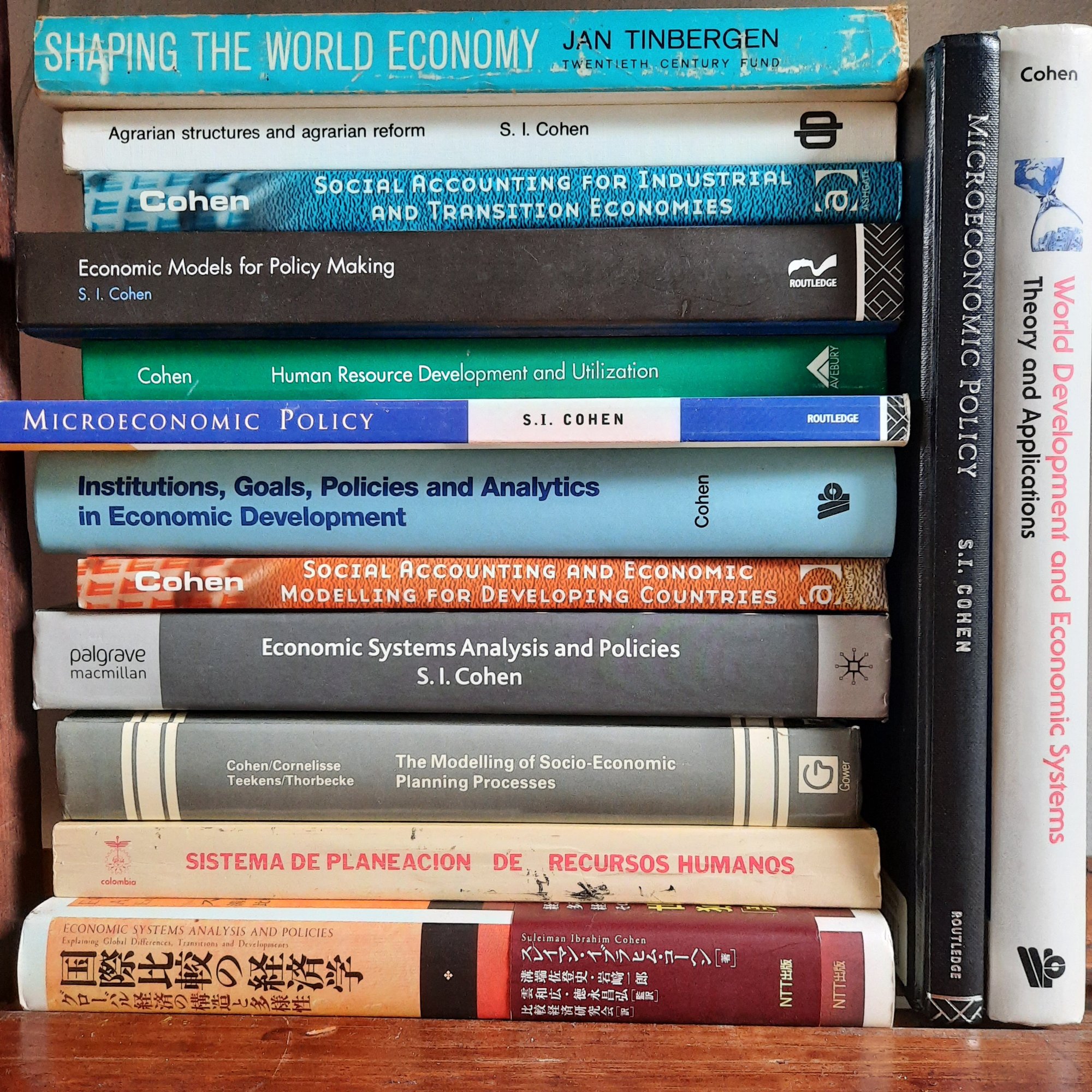
Founder is Suleiman (Solomon) Cohen, Emeritus Professor at Erasmus University Rotterdam. Born in El Fayoum, Egypt, he obtained a bachelor's degree in economics at the University of Khartoum, Sudan, and a PhD in economics at the Netherlands School of Economics in Rotterdam.
He joined Jan Tinbergen's research group in the early to mid-1960s, then known as the Department of Balanced International Growth, focusing on raising development levels of developing countries. The foundation's name relates to the same context and objective.
If interested to know more on the founder see website sicohen.com.
ECO-BID supports sustainable progress in developing countries by investing in education and careers, community development, and knowledge transfer.
ECO-BID invests in human capital as the foundation of economic and social advancement. Efforts focus on intermediate education and expanding access to university education and professional training, particularly for talented individuals from underserved backgrounds.
This includes scholarships, fellowships, university infrastructure improvements, faculty development, and programs that align academic curricula with labour market needs in emerging economies.
By equipping young people with advanced skills, critical thinking, and leadership capabilities, ECO-BID aims to support a new generation of professionals, entrepreneurs, and innovators who can drive development and reduce inequalities.
ECO-BID supports holistic, asset-based community development that empowers impoverished populations to break cycles of poverty through their own productive efforts.
The approach emphasizes strengthening human capital (skills, health, education) and social capital (trust, networks, cooperation, community organizations). Initiatives prioritize sustainable livelihoods such as cooperative enterprises, value-chain enhancements in agriculture and small-scale industry, access to microfinance and markets, and climate-resilient practices.
Rather than temporary handouts, the foundation supports projects that build local ownership, leadership, and institutions capable of self-maintenance and replication.
Strong, effective institutions are essential for lasting development. ECO-BID supports the creation, strengthening, and modernization of local organisations, including NGOs, community-based groups, research centres, cooperatives, and public-interest entities.
Support can focus on governance, financial sustainability, transparency, and impact. These efforts build bridges for mutual benefit, share best practices, and amplify collective impact on shared challenges such as education, health, economic inclusion, and environmental sustainability.
Knowledge is a powerful catalyst for change and development. ECO-BID promotes the generation, dissemination, and application of relevant, context-specific knowledge to inform policy, practice, and innovation in developing countries.
A key pillar involves fostering global collaboration and exchanges: partnerships between institutions, peer-to-peer learning, joint programs, professional exchanges, and cross-border networks.
The foundation can support collaborations in pilot projects, applied research, evaluations that address priority local issues, and the production and open-access dissemination of publications such as toolkits, case studies, and policy briefs.
Read how ECO-BID plans funding, spending priorities, and implementation.
This work plan outlines ECO-BID's funding approach, spending priorities, program focus, and implementation mechanisms.
The founder commits to grant annually a pre-specified sum for five years starting in 2026. Funding may be increased if the realised absorptive capacity is high.
Toward the end of the five-year period, the governing board will evaluate achievements and assess continuation prospects.
Spending objectives are guided by these proportions. Percentages are guidelines, not absolute targets.
Human capital as the primary driver of long-term development.
Sustainable livelihoods and social resilience.
Research, collaboration and open-access publications.
Reimbursed operational costs only. No staff remuneration.
Under- or overspending in one category may be compensated in following years.
ECO-BID donations in coming years continue the three-pillar activities of past years, at a more systematic and elevated level. While 2026 is intended as the first year of reactivated full-scale ECO-BID, 2027 is more likely due to the time needed to establish aiding links. Partial donations can be made in 2026.
Main recipients include Comboni College Khartoum and the Economics Faculty of the University of Khartoum, associated with the founder and academic advisors. Discussions were interrupted due to the warfare situation in Sudan. As the situation calms, communications and grant details may resume.
Similar initiatives are taking place with universities in Nepal and Suriname. ECO-BID also continues annual donations to UAF.
ECO-BID intends to continue donations to several agencies, including Max Maakt Mogelijk, which focuses on improving living conditions of vulnerable elderly people in parts of Eastern Europe, Africa and Asia.
Other agencies include Wilde Ganzen, SIW and SNV. ECO-BID may also take a more active field role in community development in one or more developing countries.
Knowledge transfer is realised via collaborations and exchanges, and via research and publications. ECO-BID focuses on knowledge topics that promote commonality and more balanced world development.
In addition to partnering institutions in Nepal, Sudan, and Suriname, possible partnering institutions may be examined in Turkey, Indonesia, Pakistan, Morocco and Peru.
Guiding principles are effectiveness and accountability. Direct donations may take place where long-established and trusted links exist with the benefiting institution.
Otherwise, donations are directed to established assistance agencies targeting disadvantaged groups. Where feasible, grants can be earmarked to specified ends in consultation with the executing agency.
The three-activities program can be repeated annually with learn-as-you-go modifications. These activities contribute to raising living levels in recipient developing countries and, in relative terms, contribute to a more balanced world development.
This page provides the information typically required for public benefit organisations, including legal status, statutory purpose, governance and financial accountability.
De stichting economie ter bevordering van gelijkwaardige internationale ontwikkeling heeft ten doel het zowel op eigen initiatief als op verzoek van derden verrichten of steunen van activiteiten die bijdragen aan een gelijkwaardiger ontwikkeling tussen bevolkingsgroepen en/of landen, gebaseerd op wederzijds begrip en samenwerking als voorwaarden voor succes en nadruk leggend op een economisch-sociale benadering.
De stichting tracht dit doel te bereiken door:
De stichting heeft geen winstoogmerk.
The foundation aims to undertake or support activities that contribute to a more equitable development between population groups and/or countries, based on mutual understanding and cooperation as conditions for success, emphasizing an economic-social approach.
The foundation seeks to achieve this goal by promoting education and career development, supporting disadvantaged communities, enabling knowledge transfer through collaboration and research, and using other lawful means that support the foundation's continuity, all for the benefit of less privileged groups globally.
The foundation has no profit motive.
While the governing board and academic advisors cooperate collectively, the board has the final say in spending decisions. The decision-making process is compliant with governance codes.
The foundation does not have employees. It is run by board members with support from academic advisors. Board members and academic advisors are not remunerated for their services.
The foundation observes compliance with ANBI financial reporting requirements.
The chairman ensures that the annual activities report is produced in the first quarter of the following year, reporting how funds are allocated and how goals are met.
The treasurer supplies the assigned accountant with details of financial transactions, including income, spending and reserves. The annual financial report should be available for inspection before the end of the first quarter of the following year.
Invitation; You are invited to propose implementable ideas that the Foundation can evaluate and eventually pursue in achieving the Foundation objectives. You are also welcome to contribute in kind via donations that are tax-deductible.
For questions about the foundation, our activities or collaboration opportunities, please reach out by email, or use the contact form below.
We welcome enquiries from individuals, institutions and organisations who share our commitment to equitable international development.
Our Privacy Statement is currently being prepared.
It will be published on this page shortly. If you have any questions in the meantime, please contact us.